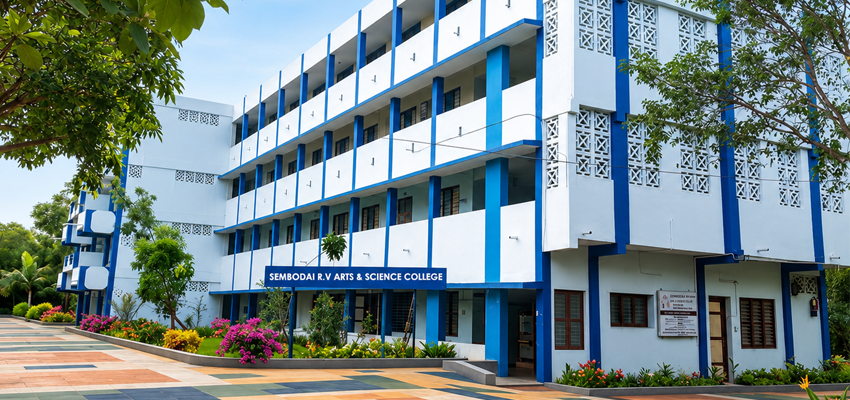
Sembodai R.V. Arts & Science College follows a well-structured academic system designed to provide quality higher education with a balance between theoretical knowledge and practical learning. The institution adopts a student-centric approach that encourages intellectual growth, discipline, skill development, and professional competency. The academic framework is aligned with the regulations and curriculum prescribed by the affiliated university and higher education authorities.
The college emphasizes continuous learning through classroom teaching, laboratory training, seminars, projects, workshops, assignments, and co-curricular activities. The academic system focuses on holistic student development by integrating knowledge, ethics, communication skills, and employability enhancement.
The curriculum framework of the institution is designed to provide comprehensive subject knowledge, practical exposure, and career-oriented learning opportunities. The programmes offered by the college are structured to meet current academic standards and industry expectations.
The curriculum framework encourages analytical thinking, innovation, research orientation, and holistic learning among students.
The institution follows an Outcome Based Education (OBE) approach that focuses on achieving specific learning outcomes and professional competencies among students. The academic system is designed to ensure that students acquire knowledge, practical skills, communication abilities, leadership qualities, and ethical values necessary for personal and professional success.
The institution continuously monitors academic performance and learning outcomes to ensure quality education and student progression.
The college adopts innovative and student-centered teaching methodologies to create an effective and engaging learning environment. Faculty members utilize modern teaching techniques that encourage active participation, conceptual understanding, and practical learning.
The institution continuously encourages faculty members to adopt innovative teaching practices that enhance academic excellence and student engagement.
The institution follows a transparent and systematic internal assessment process to evaluate students’ academic performance and continuous progress. Internal assessments are conducted periodically to measure students’ understanding, participation, and practical competencies.
The internal assessment process helps students identify their strengths and areas for improvement while encouraging regular academic involvement.
The college follows the examination regulations prescribed by the affiliated university. Examinations are conducted in a disciplined and transparent manner to maintain academic integrity and fairness.
The institution ensures smooth and systematic conduct of examinations while maintaining academic standards.
The institution prepares a comprehensive academic calendar at the beginning of every academic year to ensure effective academic planning and smooth execution of educational activities.
The academic calendar helps students and faculty members plan academic activities efficiently.
The college offers value-added courses to enhance students’ employability, technical skills, communication abilities, and professional competencies. These programmes provide additional practical exposure beyond the regular curriculum.
These courses help students become industry-ready professionals with enhanced career opportunities.
The institution gives special importance to communication skill development to improve students’ confidence and professional competency. Communication training programmes are conducted regularly to strengthen speaking, writing, listening, and presentation abilities.
The communication skill training programmes prepare students for higher education, interviews, corporate environments, and public interaction.
The college provides digital learning support facilities to enhance modern educational experiences and technology-enabled learning. Faculty members integrate digital resources into classroom teaching to improve conceptual understanding and student engagement.
Digital learning support helps students gain exposure to modern educational technologies and self-learning opportunities.
The institution provides remedial coaching programmes to support academically weaker students and help them improve their subject understanding and examination performance. Faculty members offer individual attention and special coaching sessions for students requiring academic assistance.
These initiatives help students improve confidence, academic performance, and overall learning outcomes.
The college follows an effective mentor system to provide academic guidance, personal support, and career counseling for students. Faculty members are assigned as mentors to monitor students’ academic progress, attendance, behavior, and overall development.
The mentor system helps create a supportive learning environment that encourages student success and holistic development.
"Explore, Learn, and Lead—Your journey to excellence starts here."
Let,s Get Started